
AF Calculators
Sign In to Continue
This page is private — please enter your credentials.
Not a Prime Member yet?
Sign UpPCSUnited was built to help military members and their families make smarter, clearer decisions during one of the most stressful parts of military life: the PCS move. Instead of forcing users to jump between pay charts, housing websites, base pages, and scattered calculators, PCSUnited brings key relocation, compensation, housing, and readiness tools into one guided experience. The goal is simple: help service members understand their numbers, compare their options, and move forward with confidence before making major housing or financial decisions.

From Retired Combat Veteran to a Senior Business Analytst at Sandia National Laboratories, the skills and scope of knowledge have been tailored to bring you the best possible platform.
As a lifelong learner the education and knowledge gained from Ivy League Plus Universities has been paramount in the development of PCSUnited.
PCSUnited exists to give military families a clearer, calmer, and more informed path through the PCS process. A move is never just a change of address. For most service members, it affects housing, finances, schools, commute, family routines, long-term wealth, and overall quality of life. Yet the information needed to make those decisions is often scattered across pay charts, base websites, housing listings, lender estimates, social media groups, and word-of-mouth advice. PCSUnited was created to bring those pieces together into one trusted decision platform built specifically around the needs of military members and their families.
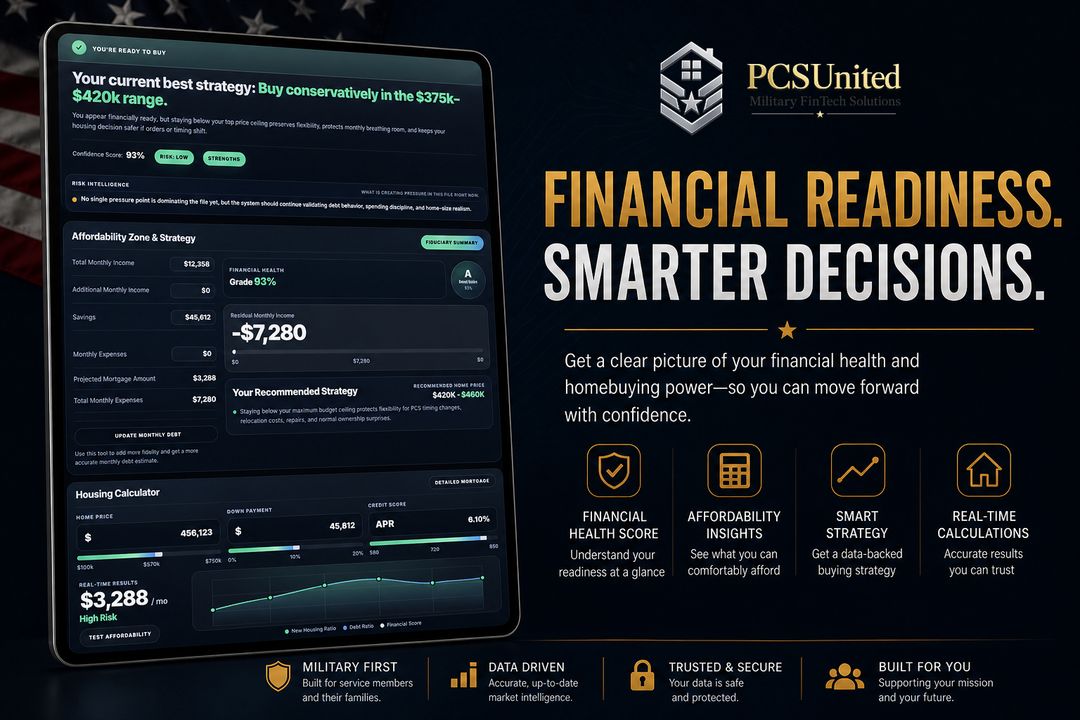
The purpose of PCSUnited is to help users understand their situation before they make major housing and financial decisions. Instead of simply showing generic calculators or broad relocation content, PCSUnited connects military pay, BAH, BAS, base location, local housing data, affordability guidance, mortgage estimates, commute preferences, and family lifestyle needs into a more complete planning picture. The platform is designed to help users answer practical questions: What can I afford? Should I rent or buy? What type of home fits my family? How does this base compare to my current situation? Am I financially ready to purchase, or should I wait?
The vision is to become the decision-first relocation and housing intelligence platform for the military community. PCSUnited is not meant to replace official resources, finance offices, lenders, real estate professionals, or installation guidance. Instead, it acts as a smart support layer that helps users organize their information, understand their numbers, and prepare better questions before speaking with professionals. By combining structured data, housing psychology, affordability modeling, base demographics, and A.I.-assisted guidance, PCSUnited turns a stressful PCS move into a more strategic process.
Long term, PCSUnited aims to help military families move with more confidence and less guesswork. Whether a user is researching a new duty station, estimating monthly compensation, exploring homeownership, comparing neighborhoods, or building a housing profile, the platform is designed to make each step easier to understand. The mission is simple: reduce confusion, protect families from rushed decisions, and help service members choose housing options that support both their financial readiness and their everyday life. PCSUnited’s vision is to become the trusted starting point for military relocation, housing clarity, and smarter moves home.
During my Masters of Quantative Management: Business Analysis program at Duke's Univerisity, Fuqua School of Business, I was given enormous tools and insight into Data Science, and A.I Integration principles. This foundation rapidly evolved into the backbone of PCSUnited.
Through advanced coursework in data architecture, you will learn to structure scalable databases capable of handling high-volume user traffic. Predictive modeling and machine learning skills will enable you to design custom algorithm engines, personalizing content delivery for your community.Additionally, Fuqua’s rigorous team-based environment trains you to lead cross-functional developer squads and manage strict digital product roadmaps. This rare combination of data science mastery and strategic business leadership ensures your platform is highly scalable, user-centric, and commercially viable from launch.
ortage & Buy /Do-Not-Buy Calcutation Summary:
"Our Math is Honest and based on Department of Air Force Instructions"
PCSUnited and OrozcoRealty estimate home-buying readiness by calculating the user’s true all-in monthly housing cost and comparing it against income, existing expenses, debt, savings, and credit strength. The system does not rely only on whether a user may qualify for a mortgage. Instead, it evaluates whether the home appears financially sustainable after the full monthly load is considered.
The mortgage calculation starts with the projected home price and down payment. The basic formula is:
Down Payment Amount = Home Price × Down Payment Percentage
Loan Amount = Home Price − Down Payment Amount
The system then estimates the annual percentage rate, or APR, from the user’s credit score. For example, a score of 780 or higher uses an estimated APR of 6.10%, 740–759 uses 6.45%, 700–719 uses 6.95%, 660–679 uses 7.55%, and scores below 640 use 8.25%. These APR bands are planning assumptions, not lender quotes.
The monthly principal and interest payment is calculated using the standard amortized mortgage formula:
Monthly Interest Rate = APR ÷ 12
Number of Payments = Loan Term Years × 12
Principal & Interest = Loan Amount × [r × (1 + r)^n] ÷ [(1 + r)^n − 1]
Where r is the monthly interest rate and n is the number of monthly payments. If the interest rate is 0%, the system simply divides the loan amount by the number of payments.
PCSUnited then adds ownership costs that many buyers overlook. Property taxes default to about 1.2% of the home price per year unless a more specific value is available. Homeowners insurance defaults to about 0.35% of the home price per year unless a better local estimate exists. HOA and PMI are added when available. The all-in mortgage estimate is:
Monthly Property Tax = Home Price × Tax Rate ÷ 12
Monthly Insurance = Home Price × Insurance Rate ÷ 12
All-In Monthly Mortgage = Principal & Interest + Monthly Property Tax + Monthly Insurance + HOA + PMI
The buy-or-do-not-buy decision comes from comparing this all-in mortgage against the user’s income and total monthly obligations. The system calculates:
Non-Housing Load = Monthly Expenses + Monthly Debt
Total Monthly Load = All-In Mortgage + Monthly Expenses + Monthly Debt
Residual Income = Monthly Income − Total Monthly Load
Housing Ratio = All-In Mortgage ÷ Monthly Income × 100
Debt-Only Ratio = Monthly Debt ÷ Monthly Income × 100
Total Load Ratio / DTI = Total Monthly Load ÷ Monthly Income × 100
The readiness model then scores five areas: housing ratio, total load ratio, residual income, savings/down payment strength, and credit score. Housing ratio receives 26% of the score, total load ratio receives 28%, residual income receives 22%, savings receives 12%, and credit score receives 12%.
A housing ratio at or below 25% scores strongest. Around 30% is still healthy. Above 35% starts becoming risky, and above 40% is heavily penalized. For total monthly load, 28% or below is strongest, 36% or below is generally safe, 43% or below is workable but tighter, and anything above 50% is considered financially pressured. Residual income is also critical: $2,500 or more remaining monthly scores strongest, while low or negative residual income signals financial stress.
The final score becomes a financial grade. Higher scores produce Safe or Stable recommendations. Lower scores produce Caution or Stressed recommendations. In plain terms, PCSUnited may support buying when the user’s all-in mortgage is near or below 30% of income, total monthly load remains manageable, residual income stays positive, savings are adequate, and credit strength supports a reasonable rate. The system may recommend waiting or not buying yet when the mortgage creates a high housing ratio, total obligations consume too much income, residual income is weak or negative, or debt and expenses leave the user financially fragile.
CSUnited uses the Housing Quiz and A.I.O.U. Assumption Test to understand more than what a user says they want in a home. The goal is to identify the emotional, practical, and personality-driven patterns behind a housing decision.
A PCS move often forces families to make tradeoffs between price, commute, space, school access, home condition, neighborhood feel, and long-term comfort. Because of that, PCSUnited does not treat housing preferences as simple checklist items. Instead, the quiz is designed to reveal the user’s decision style, lifestyle pull, risk tolerance, flexibility, and discipline before those preferences are compared against real affordability and market conditions.
The first Housing Quiz creates a baseline profile through five lifestyle questions. Users choose the type of home identity that feels most accurate, the bedroom and bathroom count they want, the compromise they would protect first, their commute comfort zone, and their preference between a home that may need repairs versus a brand-new or move-in-ready home. These answers are converted into five behavioral scores: Openness, Discipline, Lifestyle Pull, Flexibility, and Risk Aversion. Each score begins at a neutral baseline of 3 on a 1-to-5 scale. User answers then adjust the score up or down depending on what the answer reveals. For example, choosing a practical and financially smart home increases Discipline, while choosing an elevated lifestyle increases Openness and Lifestyle Pull. Choosing to protect payment increases Discipline and Risk Awareness, while choosing to protect space or condition reveals stronger emotional or comfort-based housing priorities.
PCSUnited then uses the A.I.O.U. Assumption Test to pressure-test those preferences. The purpose is to see whether the user’s first-pass housing desires stay consistent when tradeoffs are introduced. The A.I.O.U. questions use timed responses, paired control questions, reverse-scored items, and visual preference sliders. If the user does not answer within the timer, the system records a neutral response. This helps distinguish between strong preferences and uncertain preferences. Several questions are intentionally paired against each other. For example, one question may test whether the user is tempted to stretch for a home they love, while the paired question tests whether they would walk away if the numbers do not make sense. If the two answers strongly conflict, PCSUnited flags an assumption mismatch. These flags are not treated as “bad” answers. They simply show where a user may emotionally want one thing but financially or logically claim another.
The quiz also uses an MBTI-style buyer guide as a personality translation layer. PCSUnited does not use MBTI as a medical, clinical, or official psychological diagnosis. Instead, it uses MBTI-inspired language to make housing behavior easier to understand. The system maps the five internal scores into a familiar personality-style label. Higher Lifestyle Pull influences the Extraversion/Introversion side, higher Openness influences the Sensing/Intuition side, higher Flexibility influences the Thinking/Feeling side, and higher Discipline influences the Judging/Perceiving side. This creates a housing persona such as Inspector, Protector, Architect, Artist, Executive, or Commander.
The final result combines baseline housing preferences, assumption consistency, MBTI-style interpretation, and behavioral scoring. This gives PCSUnited a clearer picture of whether the user is a payment-disciplined planner, emotion-led dream hunter, risk-guarded nest-builder, flexible family optimizer, design-forward value seeker, or balanced explorer. The purpose is to help users understand how they make housing decisions before affordability pressure, market limitations, or emotional home-shopping momentum push them into a poor choice.
By using standard psychology practices, and principle I was able to replicate a "Personality Test" for Real Estate. I wanted to replicate a predicatble model, to test true housing wants vs needs. The purpose is to provide users with insight on their own true wants and need.
"I wanted to replicate a predicatble model, to test true housing wants vs needs,."
igital artwork is provided free. Donations are optional and help support PCSUnited operating costs, including website hosting, APIs, software tools, design tools, and future resource development. After operating costs are covered, a portion of remaining donations may be directed toward veteran and military-family charities
Lorem ipsum dolor sit amet, consectetur adipiscing elit. Suspendisse varius enim in eros elementum tristique. Duis cursus, mi quis viverra ornare, eros dolor interdum nulla, ut commodo diam libero vitae erat.
The website template and all associated content, including but not limited to text, graphics, logos, and images, are the intellectual property of [Your Company]. You may not modify, reproduce, distribute, or display any part of the template without our prior written consent.
You are granted a non-exclusive, non-transferable license to use the website template for your own personal or business use. You may not sublicense, sell, or distribute the template to third parties without our express written permission.
You are responsible for any content you post or upload to the website template. By submitting content, you grant us a non-exclusive, worldwide, royalty-free license to use, reproduce, modify, adapt, publish, and display the content for the purpose of operating and improving the template.
When using the website template, you agree not to: Violate any applicable laws, regulations, or third-party rights. Engage in fraudulent, deceptive, or unlawful activities. Interfere with or disrupt the functionality of the template or its associated servers. Upload or transmit viruses, malware, or any other harmful code. Attempt to gain unauthorized access to the template or its related systems.
We strive to provide accurate and up-to-date information on the website template. However, we do not guarantee the accuracy, completeness, or reliability of any content. You agree to use the template at your own risk, and we shall not be liable for any damages arising from your use of the template.
The website template may contain links to third-party websites or services. We do not control or endorse the content or practices of these third-party sites. Accessing such sites is at your own risk, and you should review their respective terms and privacy policies.
We reserve the right to terminate or suspend your access to the website template at any time, with or without cause. Upon termination, you must cease all use of the template and destroy any copies in your possession.
These Terms and Conditions shall be governed by and construed in accordance with the laws of [Your Country]. Any disputes arising from the use of the website template shall be subject to the exclusive jurisdiction of the courts in [Your Jurisdiction].
We may revise these Terms and Conditions at any time without prior notice. By continuing to use the website template after any modifications, you agree to be bound by the updated Terms and Conditions.
Disclaimer: PCSUnited is an independent decision platform. The financial models, behavioral metrics, and opinions expressed herein belong solely to the creator. They do not represent, imply endorsement by, or reflect the official policies of Sandia National Laboratories, Duke University, Johns Hopkins University, or the United States Armed Forces